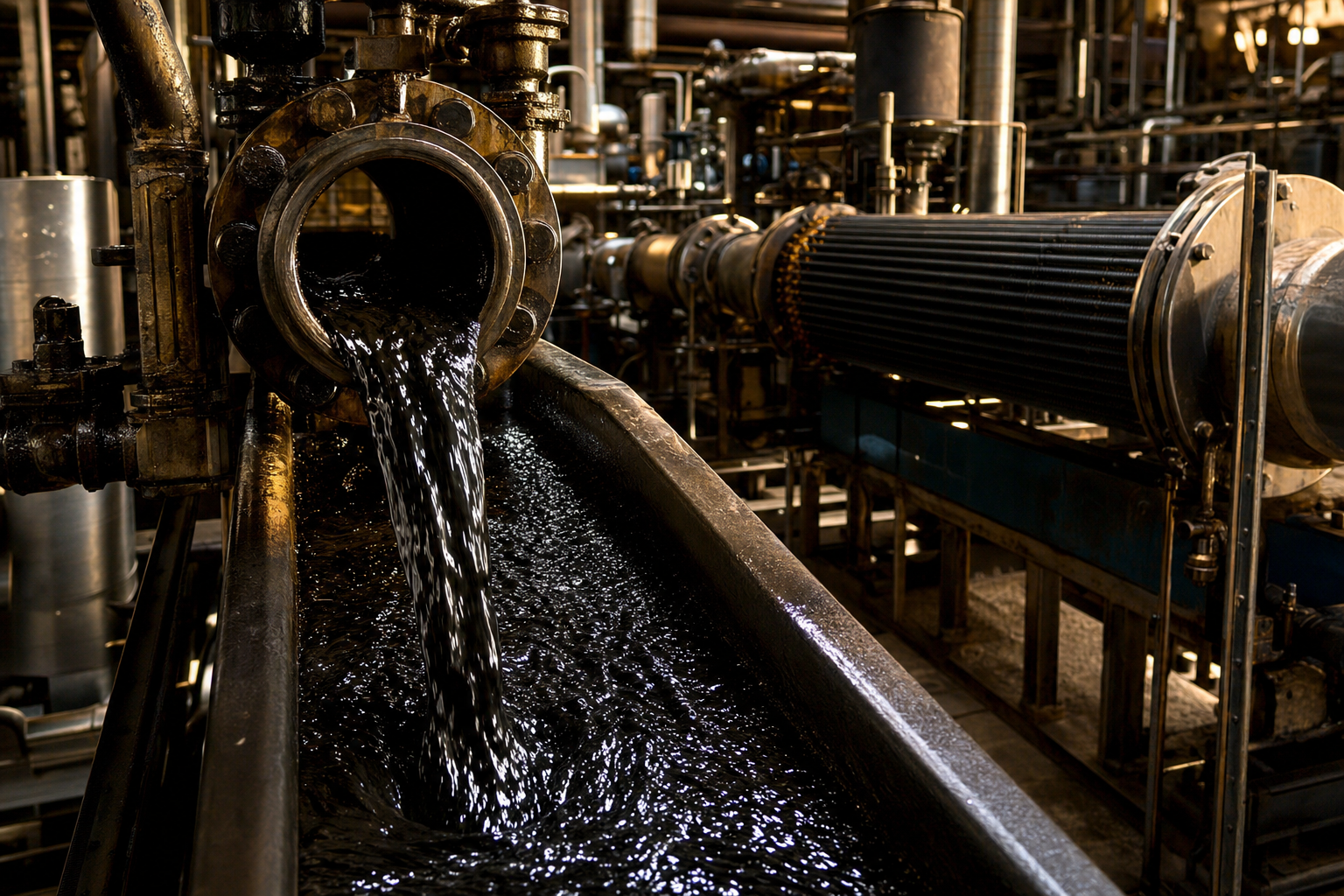
Refinery sludge is not a single material waiting for a standard recipe. Tank bottoms and process sludges can hold recoverable hydrocarbons alongside water, clay, corrosion products, metals and persistent heavy fractions. The operational question is therefore not merely how much oil is present, but what is present with it, how consistently it is distributed and what the recovered stream is meant to do next.
The feed changes from tank to tank
Tank-bottom sediment forms as heavier hydrocarbons and clays precipitate from crude oil. Its composition then changes with crude origin, residence time, temperature, tank history and exposure. A systematic review identifies moisture, total solids, density, pH, petroleum-hydrocarbon fractions, organic load and elemental composition, including metals, as important variables for selecting treatment. That variability is why a visual estimate or a single convenient scoop is a weak basis for process design.[2]
Sampling should represent the material that will actually be processed. The useful plan may involve multiple depths or locations, defined mixing or compositing, preserved splits and laboratory analysis matched to the recovery decision. Historical EPA work illustrates the principle: tank contents were mixed before sampling, while difficult wet or inconsistent samples were homogenised and quartered before analysis.[1]
Separate in stages, not by assumption
A treatment train begins by making the feed pumpable where appropriate, then separating three phases: free or liberated oil, aqueous liquid and solids. The sequence depends on emulsion stability, viscosity, particle size, wax, temperature and contaminant loading. In a refinery-specific characterisation study, the phases were assessed separately because each carried different analytical questions and valorisation possibilities.[2]
This is also a management discipline. A recovered oil stream does not erase the water and solids created during treatment. Reviews note that some routes generate wastewater or secondary residues, while thermal routes can create gases or chars requiring their own controls. The best process balances recovery with a clear, testable plan for every output.[2]
Recovered oil must earn its specification
Oil that looks dark and mobile is not automatically suitable for return to a refinery process, blending, fuel use or another outlet. Operators should establish acceptance criteria for the intended destination and test the recovered stream for relevant water, sediment and solids, density or viscosity, hydrocarbon fractions and contaminants. The review literature cautions that ordinary pyrolysis can produce recovered oil of low quality; recovery quantity and product quality are separate outcomes.[2]
Analytical method matters as well. EPA research records several oil-content methods and notes that solvent choice and evaporation conditions can affect measured recovery, including the loss of volatile compounds. Results are most useful when the laboratory method, sample handling and reporting basis are consistent with the decision being made.[1]
Evidence-led treatment is the safer operating choice
Regulatory field investigations have long treated representativeness and quality assurance as central to refinery-waste characterisation. EPA used site visits, agreed sampling locations, split samples and a broad analyte list, rather than relying on a narrow visual description. That is a useful operational lesson even where the local regulatory framework differs: define the question first, then collect evidence that can answer it.[3]
In practice, a treatment trial should be judged against mass balance, phase quality and the proposed destination of each stream. This avoids confusing a high apparent oil recovery with a useful recovered product, and it makes uncertainty visible before full-scale deployment. The result is a more defensible basis for deciding whether separation, further polishing or an alternative treatment route is appropriate.
Sources & further reading
Source publication dates below are distinct from this editorial’s date. Historical guidance is used for technical context, not as a statement of current legal requirements.
- Land Treatment of Petroleum Refinery SludgesU.S. Environmental Protection Agency / University of Oklahoma · November 1984
EPA technical report used for historical tank-bottom composition context, representative mixing and homogenisation/quartering of difficult samples, and cautions around oil-content analytical methods and volatile losses.
- Trend in Research on Characterization, Environmental Impacts and Treatment of Oily Sludge: A Systematic ReviewMolecules / National Library of Medicine · 2022
Systematic review used for tank-bottom formation, variability, three-phase characterisation, treatment trade-offs, secondary residues and the finding that ordinary pyrolysis may yield low-quality recovered oil.
- Federal Register, Volume 60, Issue 223: Petroleum Refining IndustryU.S. Environmental Protection Agency / U.S. Government Publishing Office · 20 November 1995
Regulatory record used for EPA's representative refinery sampling approach, split samples, quality-assurance planning and broad target-analyte coverage.
Original AI-assisted commentary published by Slopoil. References do not imply endorsement or affiliation. This article is informational, not legal advice, a process specification or a guarantee of project performance.
Return to all insights