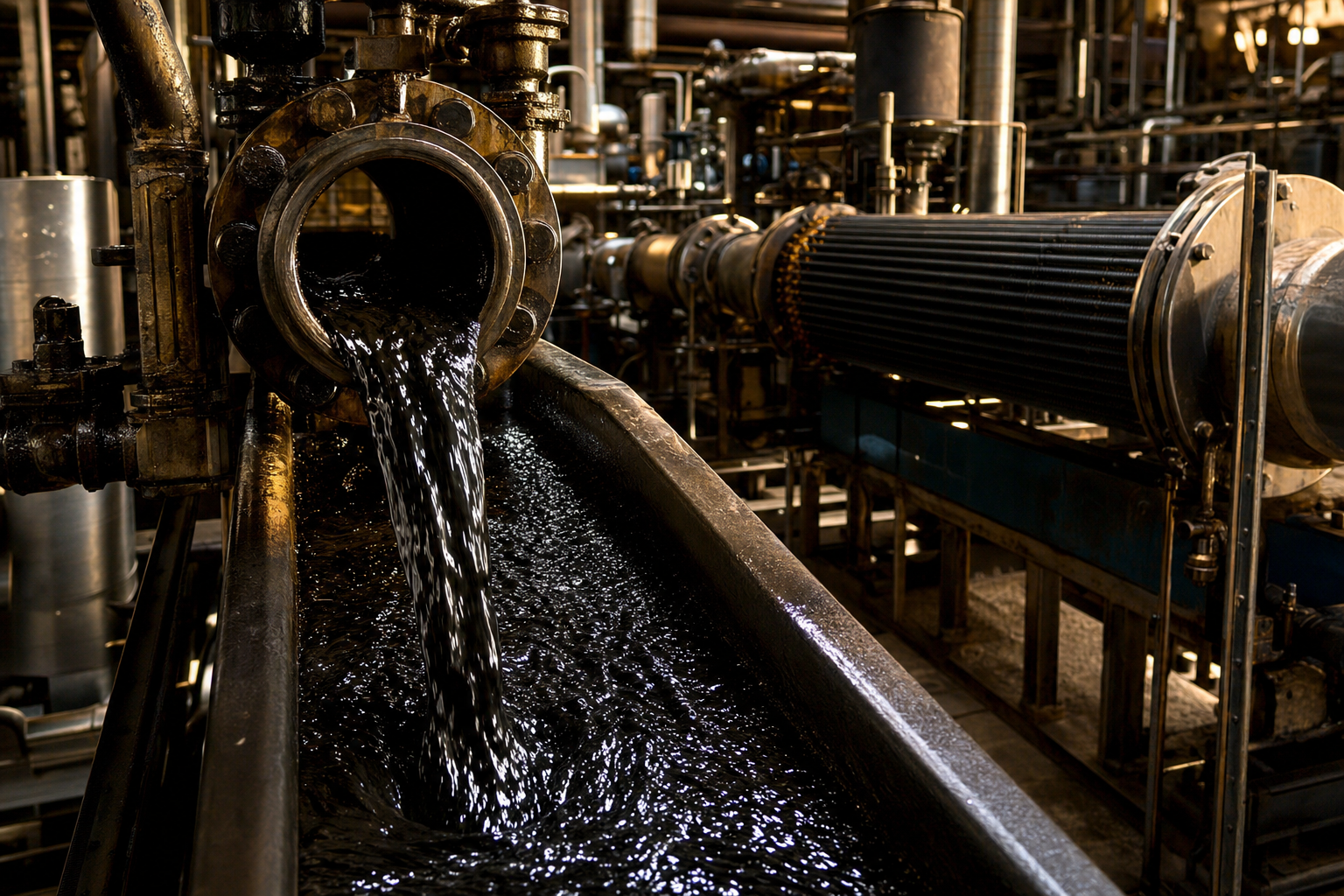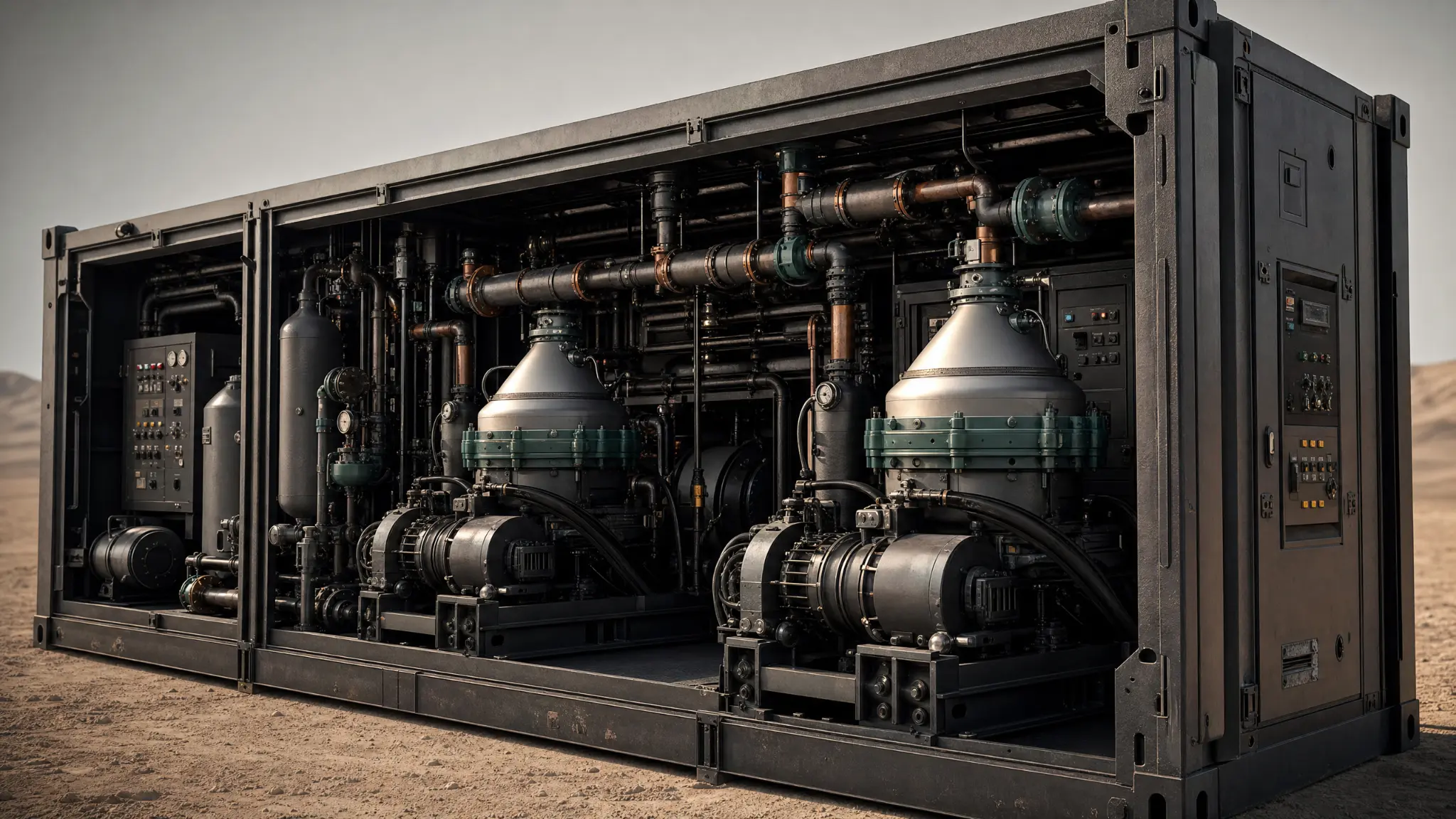
Slop oil recovery starts with a change of perspective. Tank bottoms, refinery sludges, lagoon residues and oily water may look like disposal problems, yet they can contain a recoverable hydrocarbon phase. The practical question is whether the mixture can be characterised, separated and managed so that recovery is technically sensible and the remaining water and solids follow an appropriate treatment route.
Why slop oil is difficult to recover
Oily sludge is a stable dispersion of petroleum hydrocarbons, water, solids and, in some cases, metals. Asphaltenes, resins, waxes and fine particles can stabilise emulsions, increase viscosity and hold oil against solid surfaces. That is why a tank residue cannot be judged by appearance alone: two apparently similar sludges may respond very differently to heating, settling, mixing or chemical treatment.[3]
The composition changes with origin. Free oil from a separator is a different proposition from a weathered tank bottom or lagoon sediment containing fine solids. Assessment should therefore consider water and solids content, viscosity, emulsion stability, density, hydrocarbon character and possible contaminants before a recovery route is selected. This is an operational inference from documented variability, not a promise of a particular outcome.[2][3]
Separation is a sequence, not a single machine
The basic mechanism is straightforward. In a calm separator, lighter oil rises, heavier solids settle and water occupies the middle phase. The U.S. Environmental Protection Agency describes this as primary treatment for free oil and suspended solids, with recovered oil commonly returned to the refining process. Low turbulence matters because it gives droplets time to coalesce rather than breaking them into a more stable dispersion.[1]
That principle has limits. Free oil is easier to remove than emulsified oil, colloidal material or oil bound to sludge. Depending on the feed, treatment may need staged solids removal, controlled heating, demulsification, centrifugation or polishing. Chemical cleaning can promote three-phase separation but may create an additional chemical load, while thermal and advanced methods can demand substantial energy or remain difficult to scale.[1][3]
Good recovery begins before processing
The Environment Agency’s refining guidance places emphasis on source control and segregation. Keeping contaminated and non-contaminated streams apart, preventing unnecessary dilution, and directing known spills or drain-trap contents towards oil recovery can make downstream treatment more stable. It also identifies slops plants and, in suitable cases, centrifugation as ways to recover oil from difficult wastes before final disposal decisions are made.[2]
For operators, sampling and process design should be connected. A representative sample should support a mass balance: how much hydrocarbon is potentially recoverable, how much water must be managed, what solids remain, and what quality the recovered phase needs for its intended destination. Recovery is worthwhile when the separation result and residual treatment route make sense together, rather than when a headline recovery figure looks attractive in isolation.[2][3]
A measured route from residue to resource
The strongest projects treat hydrocarbon recovery and waste management as one system. They control hazards, avoid cross-contamination, remove bulk solids where appropriate, separate phases in a controlled sequence and verify each output. Recovery does not remove the need for responsible handling of water and solids; the next step depends on composition, facility design, permit conditions and local requirements.[1][2][3]
Sources & further reading
Source publication dates below are distinct from this editorial’s date. Historical guidance is used for technical context, not as a statement of current legal requirements.
- Regulatory and Inspection Manual for Petroleum Refinery Wastewater SystemsU.S. Environmental Protection Agency · September 1991
Explains refinery primary treatment, density-based oil-water separation, quiescent zones, coalescence, free-oil recovery and the distinction between free, emulsified and colloidal oil treatment.
- How to comply with your environmental permit: Gasification, Liquefaction and Refining Installations (EPR 1.02)Environment Agency · March 2009
States that oil in sludges and other wastes represents product loss where recovery is possible; recommends source control, stream segregation, routing spills to oil recovery, slops plants and appropriate centrifugation of sludge.
- Review on oily sludge treatment technologyIOP Conference Series: Earth and Environmental Science / IOP Publishing · 2020
Reviews oily sludge composition, stable emulsions, treatment routes and their trade-offs; concludes that treatment selection should reflect feed characteristics, crude type, process features, location and feasibility.
- Slop oilGEA · Date not stated
Provides trade context on slop oil sources and staged mechanical separation, including decanter and disk-stack centrifuge configurations; used only for contextual feed variability, not independent performance or discharge claims.
Original AI-assisted commentary published by Slopoil. References do not imply endorsement or affiliation. This article is informational, not legal advice, a process specification or a guarantee of project performance.
Return to all insights